Crown Guard
Guards 6/12 - Verse 18
High guard crossing against thrusts or counter-cutting
Translation
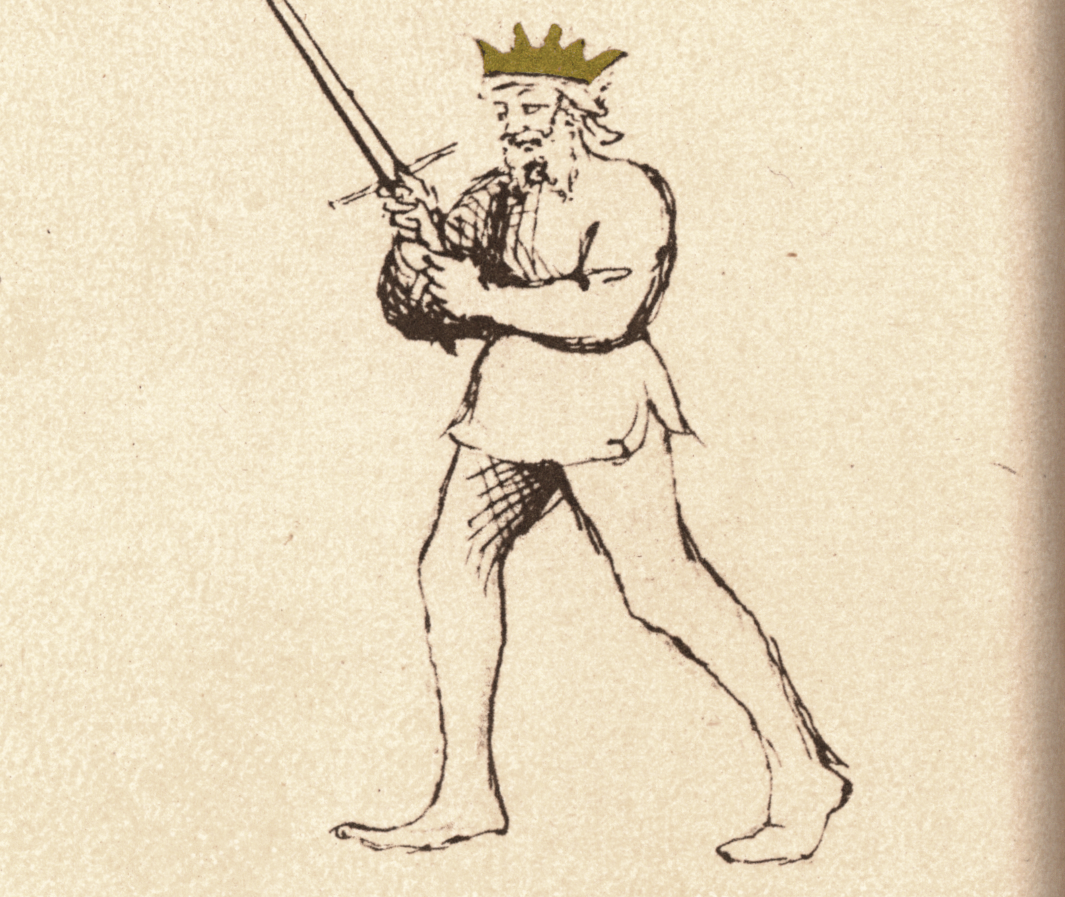
This is the Headband Stance, also called the Crown by some instructors. It is an excellent guard for parrying thrusts and defending against swords. Against a high thrust, cross the opponent's blade while stepping offline. Against a low thrust, they also step offline while driving their point to the ground. Alternatively, when they thrust, step back with the front foot and deliver a descending cut to their head or arms, ending in the Boar's Tusk guard. From there, immediately throw one or two thrusts with advancing steps, then return with a descending cut to this same guard.
Fiore's Words
I am the Headband Stance, called Crown by some, for crossing blades and thrusts. I spare no one. High thrust? I cross and step away from harm. Low thrust? I beat it down with power and calm. Or step back swift and strike your head with force, To Boar's Tusk dropping, then I change my course. Two thrusts advancing, then a descending blow, returning home to where I started, so.
Combat Context
The high guard is useful for receiving an opponent's attack, particularly effective when they commit to a thrust. The guard offers both immediate defensive options (crossing and voiding) and a more complex counter-offensive sequence that changes guards and combines cuts with thrusts. Best used when you can read your opponent's intention to thrust, allowing you to choose between safe defence and aggressive counter.
Training Notes
- ✦ Practice the offline step in both directions - it must be coordinated with the crossing action, not sequential
- ✦ When beating a low thrust to the ground, use your forte against their debole for mechanical advantage
- ✦ The backward step counter requires good measure judgment - you must create enough distance to safely deliver the descending cut
- ✦ The transition to Boar's Tusk after the descending cut should be fluid - this is a dropping motion, not a repositioning
- ✦ The advancing thrusts after Boar's Tusk must be explosive to capitalise on the tempo; practice the footwork rhythm separately
- ✦ Returning to the original guard completes the cycle - drill this as a complete phrase, not isolated techniques
This is card FL18 from the Fiore dei Liberi Sword In Two Hands deck.
Get the full deck of 78 physical training cards.
Get the deck →Next deck: Fiore Dagger - ~35 cards, in development.
· Posta frontale ditta corona Instabile [24v-c] ¶ Questa si'e posta frontale, chiamada d'alchuni magistri posta di corona, che per incrosar ella e bona, e per le punte ell'e ancora bona, che se la punta gle ven tratta erta, ella la incrosa passando fuora di strada. E se la punta e tratta bassa, anchora passa fuor di strada rebattendo la punta a terra. Anchora po far altra mente, che in lo trar dela punta torni cum lo pe indredo e vegna da fendente per la testa e per gli brazzi e vada in dente di cengiaro e subito butti una punta o doe cum acresser di pe e torni di fendente in quella propia guardia.
This is the Forehead Guard,[36] called by some instructors[37] the Crown Guard. She is a very good guard for crossing swords,[38] and is also very good against thrusts. If she is attacked with a high thrust, she crosses swords while stepping off line . If she is attacked with a low thrust, she also steps offline, but this time she drives the opponent’s sword to the ground . She can also do other things. For example, in response to a thrust she can pass backwards with the front foot and respond with a downward strike to the head or arms, ending in the Boar’s Tusk, then she can quickly throw a thrust or two with advancing steps, then deliver a downward strike, ending in that same guard.
[12v-b] Questa si e posta frontale e alchuni magistri la chiamano posta di corona. Che per incrosar ella e bona, e per le punte, ella e anchora bona che se la punta gle vene trata erta ella la incrosa passando fora de strada. E se lla punta si ven trata bassa anchora passa fora de strada rebatendo la punta a terra. Anchora po fare altramente, Che in lo trar dela punta torni cum lo pe indredo, e vegna di fendenti per la testa e per gli brazi e vada in dente do zenghiaro e subito[40] bute una punta, o doe cum acreser de pe, e torni[41] di fendent cum quella propria guardia.
This is the Headband Stance, and some Masters call her the Stance of the Crown. She is good at crossing, and she is also good against thrusts because if a point comes attacking upwards, she crosses, stepping out of the way. And she also steps out of the way if a point comes attacking low, beating the thrust to the ground. Again, she can do it differently, such that in the attack of a thrust she returns her foot behind and comes with a downward blow through the head and through the arms and goes to the Boar's Tusk, and then suddenly throws a thrust or two with an advance of her foot and returns with a downward blow from her own guard.
[18b-b] Posta frontalle e son chiamata corona De tagli e de punte a nesum non perdona
The Headband Stance, I am called the Crown; I will pardon no one, not from the edge nor from the point.
[13r-b] ¶ Frontalis situs ipse vocor / famosa corona. Nec cuique parco / cesura et cuspide rumpens.
I am called the famous Crown, the Frontlet Position itself. I don’t spare each one,[39] destroying with cuts and the point.