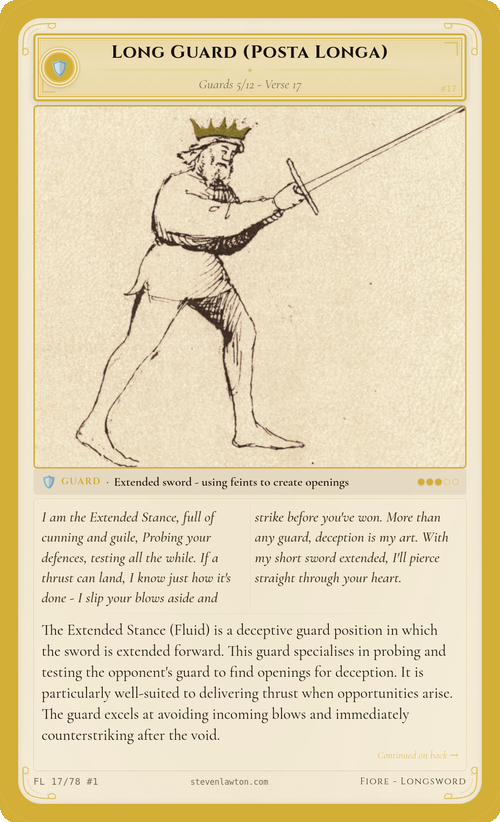

(Middle) Iron Gate
Guards 4/12 - Verse 16
Mid-level guard: thrust, beat up, cut down, recover
Translation
The Middle Iron Gate is a strong guard position held in the middle level. The guard requires keeping the sword long (extended forward). From this stance, you throw powerful thrusts and forcefully beat incoming swords upward. After deflecting, you immediately return with a descending cut to the head or arms, then recover back to the guard position. It is called 'gate' or 'door' because of its strength. It is a robust guard that cannot be easily broken without risking the attacker and without forcing engagement at close quarters.
Fiore's Words
I am the Middle Iron Gate, strong and true. I stand in the middle with my sword run through. I cast heavy thrusts and seek death with my point; I beat swords upward with force from this joint. With descending cuts to the head and to the arm, I return to my guard, keeping all from harm. They call me Gate for my strength cannot break - To pass through me, danger and close quarters you'll take.
Combat Context
A defensive middle-level guard designed to control distance with the extended point, threatening powerful thrusts. When an opponent attempts to engage, forcefully deflect their sword upward and immediately counter with a descending cut before recovering to the guard. The guard's strength lies in forcing the opponent to either accept the danger of your counter or commit to close-quarters engagement, where the narrow play begins. Effective against attacks from various angles due to the versatile middle position.
Training Notes
- ✦ Hold the sword extended forward at middle height; this is the defining characteristic of the 'middle' position
- ✦ Practice the three-part sequence: thrust from the guard, forcefully beat an incoming sword upward (likely with the true edge rising), immediately follow with a descending cut to the head or arms
- ✦ Emphasise returning to the guard position after the descending cut; the recovery is part of the technique
- ✦ The upward beat should be forceful ('per forza') to clear the line for your descending cut
- ✦ Train the guard as a defensive barrier: opponents must accept danger or close distance to break through
- ✦ The sword position should feel 'long' in the sense of reaching forward to control distance and threaten with the point
This is card FL16 from the Fiore dei Liberi Sword In Two Hands deck.
Get the full deck of 78 physical training cards.
Get the deck →Next deck: Fiore Dagger - ~35 cards, in development.
· Porta di ferro mezana, stabile · [24r-b] ¶ Questa e mezana porta di ferro per che sta in mezo. & e una forte guardia, ma ella vole longa spada. Ella butta forte punte, e rebatte per forza le spade in erto, e torna cum lo fendente per la testa o per gli brazzi, e pur torna in sua guardia. Pero ven chiamata porta per che la e forte E'de forte guardia che male se po rompere senza periculo e venire ale strette.
This is Half Iron Door, because it stays in the middle and is a strong guard. But, she wants a long sword. She throws strong thrusts and beats with force the swords upwards, and returns with a downward blow for the head or arms, and returns to its guard. But it is called Door, because it is strong and it is a strong guard that badly it can break without danger, and without coming to the close.
[12r-d] Questa e meza porta di ferro perche sta in mezo, e de una forte guardia ma ella non vole longa spada, ella zetta forte punte, e rebatte per forza le spade in erto, e torna cum lo fendent per la testa o per gli brazi, e pure torna in sua guardia. Per zo vene chiamada porta, per che ella e forte. E de forte guardia che male se po rompere senza pericolo a venir ale strette.
This is the Middle Iron Gate because she stands in the middle, and she is a strong guard but she doesn't want her sword extended. She throws strong thrusts and beats swords upward with strength, and returns with a downward blow through the head or through the arms and then simply returns to her guard. But she is well-named "gate" because she is strong; she is a strong guard that cannot be broken easily without danger and coming to the narrow.
[18a-d] Meçana porta de fero son la forte Per dare cum punta e fendenti la morte E per lungeça de spada che io me sento Del streto zogho sempre me deffendo
The Middle Iron Gate, I am strongest For giving death with thrusts and downward blows: And by extending my sword, I feel that From the narrow play I always defend myself.
[12v-d] ¶ Ferrea sum fortis / medianaque Janua dicor. Doque graves ictus. et cuspide querito mortem.
I am the strong Iron, and named[33] Door[34] in the Middle, And I give heavy blows, and I seek death with the point.