Peasant's Strike Counter
Wide Play - Verse 33
Step offline left, catch descending blow mid-blade, counter
Translation
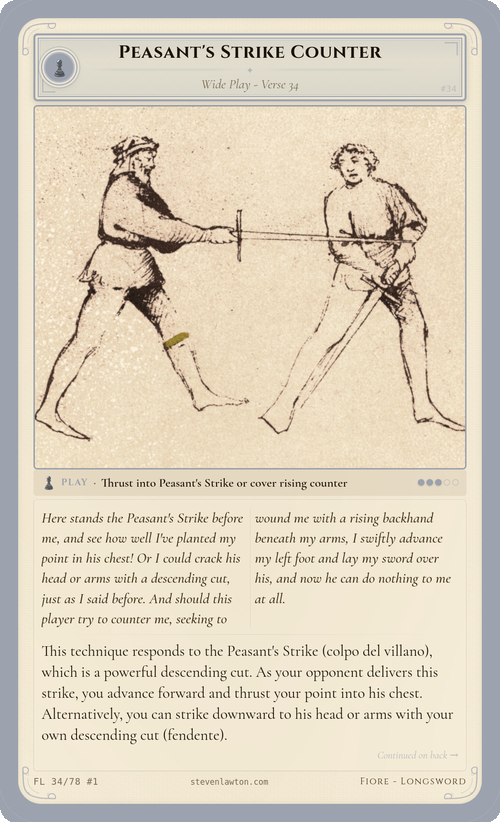
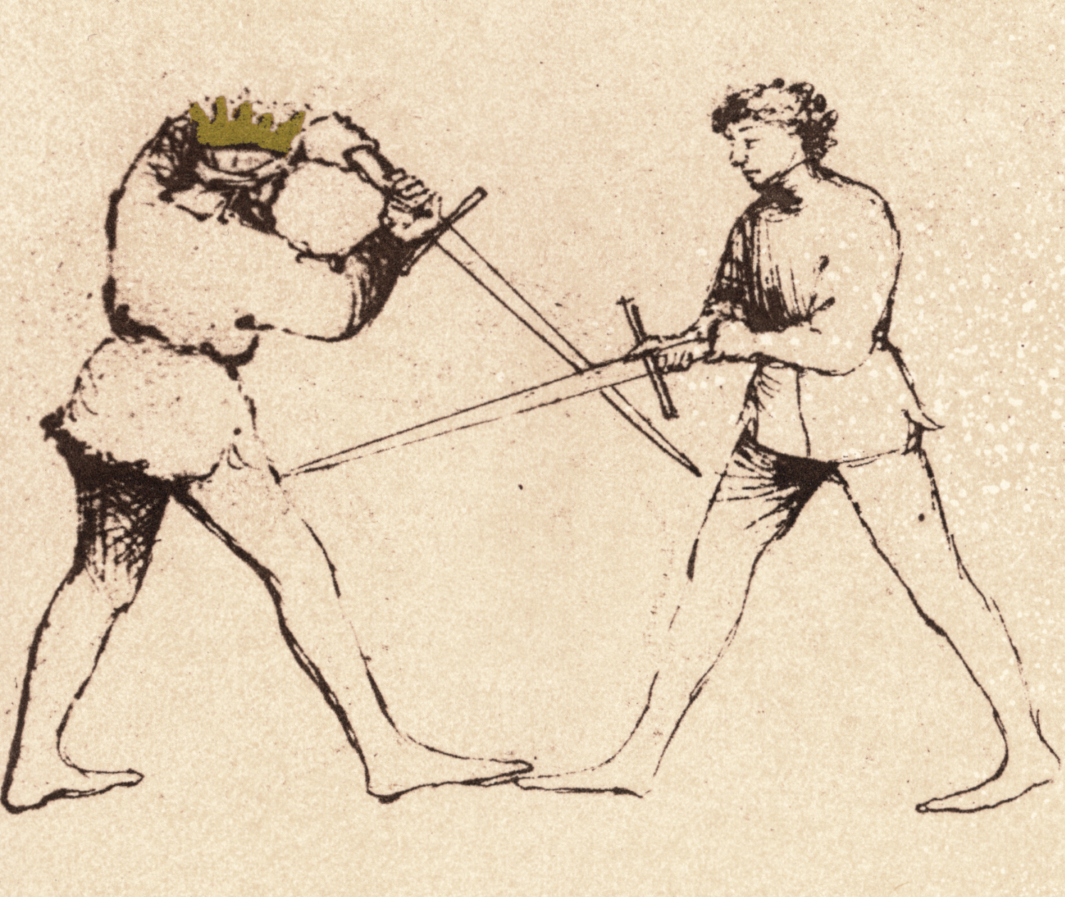
This technique counters the 'The Peasant's Strike' from an untrained opponent who commits to a powerful overhead blow. Begin with your left foot forward. As the opponent begins their overhead strike, advance your left foot forward and to your left (toward the opponent's right side), moving offline. Then pass with your right foot diagonally to the left, continuing to move offline. Catch their strike at the middle of your blade, don't attempt to stop it, let it slide down and continue to the ground. As their sword clears past you, immediately counter with a descending cut to their head or arms, or a thrust to their chest. This same technique works when fighting a sword against a poleaxe or against either a heavy or light staff.
Fiore's Words
I am the counter to the Peasant's Strike, a wild blow from one who has no art. Stand with your left foot leading. When the Peasant swings down to split your skull, step left and forward out of danger, then pass across with your right foot, catching his blow mid-blade. Let his sword run down to earth, where it belongs. Now strike! Send your cut through his head or arms, or drive your point deep into his chest. I also work against the poleaxe and the staff, for the principle remains the same.
Combat Context
Defence against an untrained or desperate opponent who commits fully to a powerful overhead blow without control or ability to recover. The technique exploits the fundamental flaw in uncontrolled attacks: once committed, the attacker cannot adapt. Most useful against opponents who rely on strength and aggression over technique, or in situations where the opponent is desperate enough to abandon defensive principles. The inclusion of poleaxe and staff suggests application against reach weapons where the opponent similarly commits to powerful strikes.
Training Notes
- ✦ The narrow stance with the left foot forward is critical; it sets up the ability to move the left foot quickly offline without crossing your feet
- ✦ The offline movement is two steps: first, advance the left foot forward and to the left, then pass with the right foot, continuing diagonally left. This creates a 'V' pattern, moving you completely off the original line
- ✦ Do not attempt to stop or block the opponent's blow with force; the mid-blade contact is for deflection, while the blade slides past
- ✦ Timing is essential: begin moving as the opponent commits to their strike, not after it has already descended
- ✦ The counter-strike must be immediate as the opponent's sword clears past you; they are overextended and committed downward
- ✦ The same footwork pattern applies whether facing sword, poleaxe, or staff, the principle of moving offline from a committed vertical strike remains constant
This is card FL33 from the Fiore dei Liberi Sword In Two Hands deck.
Get the full deck of 78 physical training cards.
Get the deck →Next deck: Fiore Dagger - ~35 cards, in development.
[26r-a] ¶ Questo zogho si'e chiamado colpo di villano e sta in tal modo, Zoe che si de aspettare lo villano che lo traga cum sua spada. E quello che lo colpo aspetta de stare in picolo passo cum lo pe stancho denanzi. E subito che lo villano ti tra per ferire, acresse lo pe stancho fora de strada inverso la parte dritta, E cum lo dritto passa ala traversa fora de strada pigliando lo suo colpo a meza la tua spada. E lassa discorrer la sua spada a terra, e subito responde gli cum lo fendente per la testa overo per gli brazi, overo cum la punta in lo petto come depinto. Anchora e questo zogho bon cum la spada contra la Azza, e contra un bastone grave o liziero.
This play is named “The Peasant’s Strike”[13] and you do it like this: take a narrow stance[14] with your left foot forward, and wait for the Peasant to attack first with his sword. When he launches his attack, immediately advance your left foot to the left off the line,[15] and step diagonally off line to the left with your right foot, receiving his strike in the middle of your sword. Now let his sword slide off yours to the ground, and then quickly counter-attack with a downward strike to his head or arms, or a thrust into his chest as you see drawn in the next picture. This is also a good play if you are fighting sword versus poleaxe, or against a heavy or light staff.
[14r-c] Questo zogo e chiamado lo colpo del vilano, e si fa per tal modo. Zoe che si de aspetare lo vilano ch'ello traga cum sua spada. E quello che aspeta lo colpo di stare in picolo passo cum lo pe stancho denanci. E in quello che lo vilano te tra per ferirte. Acrese lo pe stancho fora de strada inverso la parte dritta. E cum lo dritto pe passa ala traversa fora de strada, piglando lo suo colpo a meza spada e lassa discorere la sua spada a terra, e subito respondigli cum lo fendente per la testa overo per gli brazi overo cum la punta in lo petto come qui dipento. ancora questo e bono.
This play is called the Villain's Strike, and is made in this way: that is, that one should await the villain in this way until he strikes with his sword. And he who awaits the blow should stand in a small stance with the left foot forward. And in that moment when the villain attacks to harm you, advance your left foot out of the way against the right side.[16] And with your right foot step out of the way to the side, catching his blow at the mid-sword and allowing his sword to run off toward the ground, and then quickly respond with a downward blow (through the head or through the arms) or with your point in the chest as depicted here, this is also good.
[20a-c] Per passar fora de'strada io t'o ben discoverto E il braçi toii io si feriro in lo voltare per certo
I have uncovered you well by stepping out of the way And I will surely strike your arm while turning.