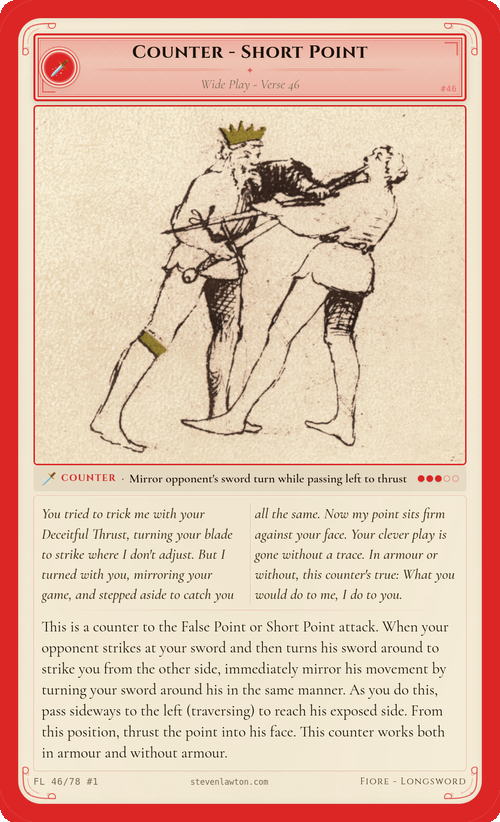

Short Point
Wide Play - Verse 45
Feint a head cut, tap his sword, half-sword thrust opposite side
Translation
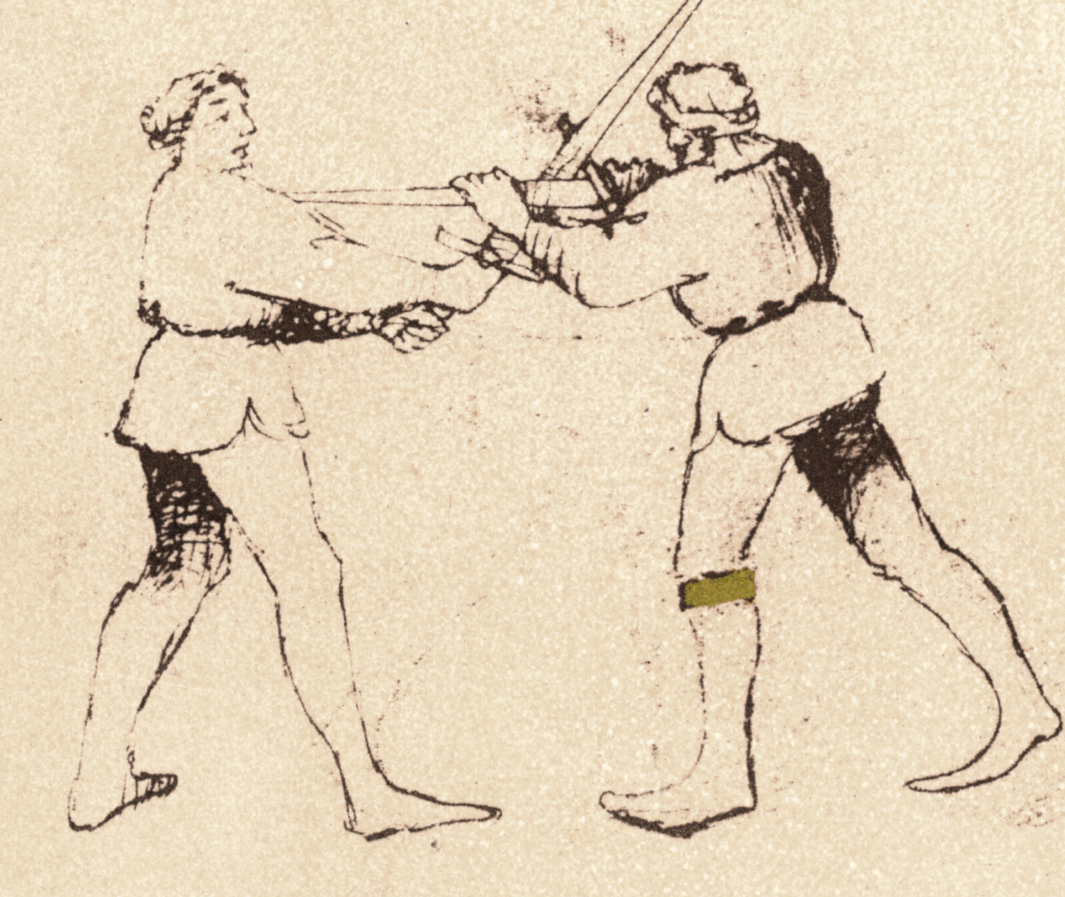
This technique is called the False Point or Short Point. Begin by appearing to commit to a powerful crosswise strike (mezzano) aimed at your opponent's head. When he moves to cover against this strike, strike his sword lightly instead of committing fully. Immediately turn your sword to the opposite side of his blade while gripping your own sword with your left hand near the middle of the blade. From this half-sword position, thrust quickly into his throat or chest. This technique is more effective when fighting in armour than without.
Fiore's Words
I am the False Point, also called the Short Point, and I trick you with what seems true. I show you a mighty blow coming crosswise at your head with such force you must defend. But when you cover, I kiss your blade so light and quick, then I am already gone to the other side! My left hand seizes my blade at the middle, and my point drives suddenly into your throat or breast. In armour I am better still, for there my cruelty has fullest flower.
Combat Context
This technique exploits the opponent's defensive reaction to an apparent committed attack. By feinting a powerful strike to the head, you provoke a covering action that opens a line for attack on the opposite side. The quick transition to half-sword allows control and precision for the finishing thrust. The technique is particularly effective in armoured combat, where the half-sword position provides leverage and where the heavier protection allows safer execution of the grip change. In unarmored combat, the practitioner must be more cautious during the transition moment.
Training Notes
- ✦ The initial strike must appear sufficiently committed to provoke a counterresponse but remain light enough for an instant recovery.
- ✦ Practice transitioning from feinting the crosswise strike to making light contact with the opponent's blade; this timing is critical.
- ✦ The sword turn, and grip change must happen as one fluid motion: drill the left hand to reach for the grip near the middle while rotating the blade to the opposite side.
- ✦ When assuming half-sword position, ensure the left hand grips firmly enough to control the point but not so far forward that you lose reach.
- ✦ The thrust should target the throat or chest, depending on the opponent's height and position after their cover.
- ✦ In armoured practice, this technique allows you to work inside the opponent's weapon after drawing their reaction.
- ✦ Without armour, be aware that you are more vulnerable during the grip transition; the feint must be more convincing to ensure commitment from the opponent.
This is card FL45 from the Fiore dei Liberi Sword In Two Hands deck.
Get the full deck of 78 physical training cards.
Get the deck →Next deck: Fiore Dagger - ~35 cards, in development.
[27v-a] ¶ Questo zogo si chiama punta falsa e punta curta, e si diro come la fazzo. Io mostro de venire cum granda forza per ferir lo zugadore cum colpo mezano in la testa. E subito ch'ello fa la coverta, io fiero la sua spada lizera mente. E subito volto la spada mia del'altra parte piglando la mia spada cum la mane mia mancha quasi al mezo. E la punta gli metto subita in la gola o in lo petto. Ed'e miglore questo zogo in arme che senza.
This play is named “The False Point” or “The Short Point”,[29] and I will explain how to do it. I make it look like I am making a powerful attack against my opponent with a crosswise strike to his head. As he makes cover I strike his sword but only lightly. Then I quickly turn my sword to the other side of his blade, gripping my sword with my left hand at about mid-sword. From there I can quickly make a thrust into his throat or chest. This play is however better in armor than without armor.
[21b-c] Mostraii de'vegner dal drito in lo riversso intraii Per darte questa punta cum dolore e guaii Punta falssa per nome io me faço chiamar Cussi son crudelle che de spada punta schambiar
I appear to come from the right, but I enter on the left To give you this thrust with great pain and harm; I make myself called Deceitful Thrust by name; And I am so cruel as I exchange the point of the sword.
[28v-c] ¶ Obliquam in partem recta d(e?) parte subivj. Hac igitur vitam linques cum cuspide tristem.
I steal in on [you] in the sly part from the honest part;[30] Therefore, you will quit this sorrowful life by means of the point.