Wide Play - Verse 35
Withdraw from leg strike, counter-cut to head
Translation
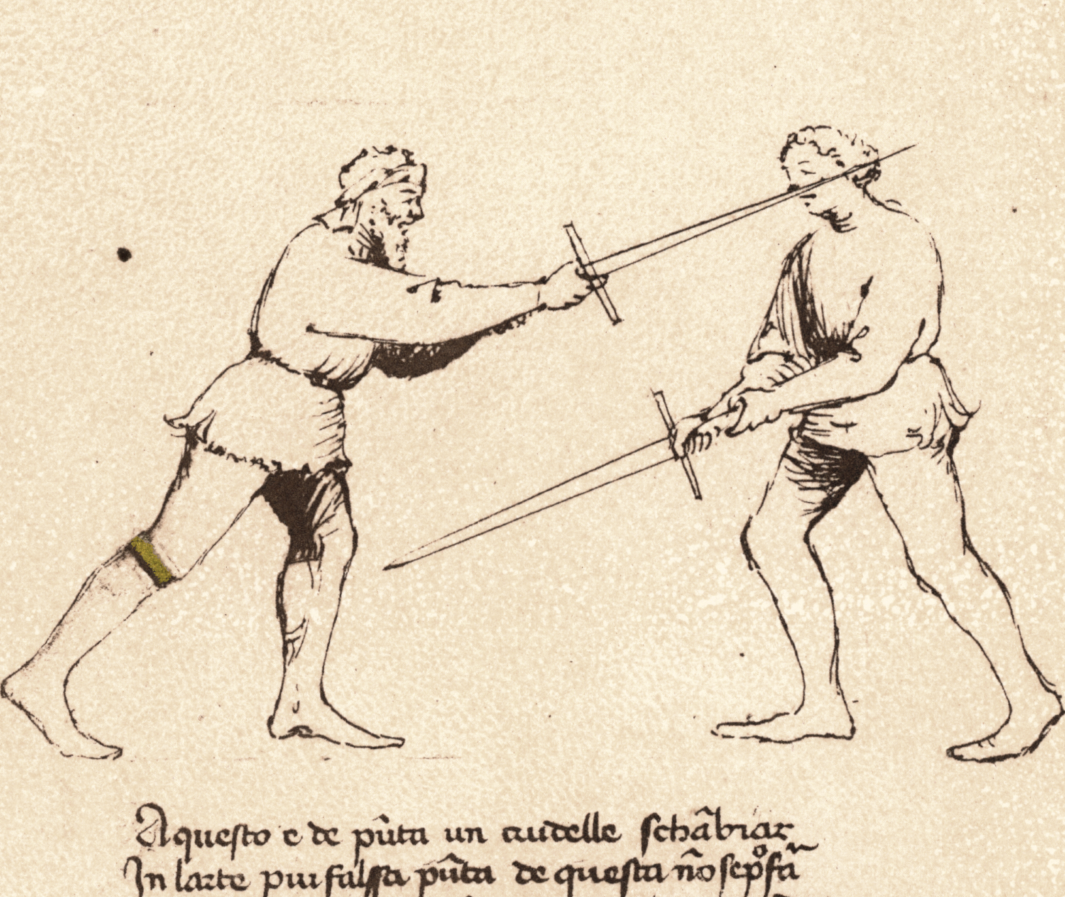
When your opponent strikes at your leg, withdraw your front foot or pass it backwards and counter with a descending cut to his head. Note that with a two-handed sword, you should not strike below the knee because it is too dangerous for the attacker; striking at the leg leaves you completely exposed and uncovered. The only exception is if you have fallen to the ground; then you may strike the leg. Otherwise, when fighting sword against sword, keep your sword opposing his sword and do not attack low.
Fiore's Words
When the sword flies for your leg, withdraw or step back in time, then strike downward to his head or cut around to his throat. Never strike below the knee with the longsword, for you leave yourself naked and open to death. The one who attacks the leg stands wholly uncovered, unless he has fallen to the earth. His arms will be wasted faster than his head because the measure closes more quickly. Sword against sword, this is the rule.
Combat Context
This technique addresses a common tactical error: attempting to strike the opponent's legs with a longsword during bound fighting. While the legs may seem like an attractive target because they are often less protected, attacking them requires breaking the structure and losing coverage in the process. The technique teaches a counterattack to exploit this tactical mistake: when the opponent commits to a low strike, they expose their entire upper body. The defender can safely remove the target (withdraw the leg) and immediately counter to the now-undefended head or throat. This principle applies specifically to sword-against-sword combat at wide play measure; the exception for ground fighting acknowledges that positional dynamics change completely when vertical distance is removed.
Training Notes
- ✦ Practice the footwork timing: the withdrawal or backward pass must happen as the opponent commits to the low strike
- ✦ The counter-cut should be delivered immediately as you remove your leg from danger. The two movements should flow together as one action
- ✦ Emphasise to students why attacking below the knee is dangerous: your hands, arms, and head are all exposed as you bend or reach down
- ✦ When practising the exception (from the ground), note that the tactical situation is completely different. Your opponent must reach down to you, reversing the exposure dynamic
- ✦ Drill maintaining sword opposition throughout. Even as you withdraw and counter, your blade should remain in relationship to the opponent's sword
- ✦ The Pisani-Dossi alternative (cut to the throat) works because it maintains better structure and coverage than cutting to the head
This is card FL35 from the Fiore dei Liberi Sword In Two Hands deck.
Get the full deck of 78 physical training cards.
Get the deck →Next deck: Fiore Dagger - ~35 cards, in development.
[26r-c] ¶ Quando uno te tra per la gamba, discresse lo pe ch'e denanzi. O tu lo torna in dredo. e tira del fendente per sua testa come qui depento. Ben che cum spada de doii man non si de trare del zinochio in zu. Pero ch'e troppo grande pericolo a choluii che tra. Ch'ello rimane tutto discoverto quello che tra per gamba. Salvo che se uno fosse cazudo in terra poria si ben trar per gamba. Ma altra mente no, siando spada contra spada.
If your opponent strikes to your leg, withdraw your front foot, or pass backwards and strike downwards to his head, as shown in the drawing. With a two handed sword it is unwise to strike to the knee or below, because it is too dangerous for the one striking. If you attack your opponent’s leg, you leave yourself completely uncovered. Now, if you have fallen to the ground, then it is all right to strike at your opponent’s legs, but otherwise it is not a good idea, as you should generally oppose his sword with your sword.
[14v-a] Quando uno te tra per la gamba, discrese lo pe ch'e denanci. O tu lo torna indredo e tra dello fendent per la sua testa. Come aqui dipento. Ben che cum spada a doe mane non se de trare dello genochio in zu, perche e tropo grande pericolo aquello che tra. Che lo romane tuto discoverto quello che tra per la gamba. Salvo che se uno fosse cazuto in terra, ben se poria trar per gamba. Ma altramente non stando spada contra spada.
When one strikes for your leg, withdraw the foot which is forward or return it behind, and throw a downward blow to his head as depicted here. Note that the sword in two hands should not attack from the knee down, because the danger to he that attacks is too great. He that attacks for the leg remains wholly uncovered, unless he would drop to the ground—then he could strike the leg well, but otherwise [he could] not when fighting sword to sword.
[20b-a] Quando la spada per la gamba si volla O fendent faii per testa, o tondo per la golla Piu tosto se guastaria li braçi che la testa Per piu curto tempo la mesura e manifesta
When a sword flies for your leg Make a downward blow to his face or around to his throat: His arms will be wasted more quickly than his head, Because the distance is manifest for a shorter time.