
Foundational theory
Foundational theory - Verse 1
Guard Relationships & Movement Types
Translation
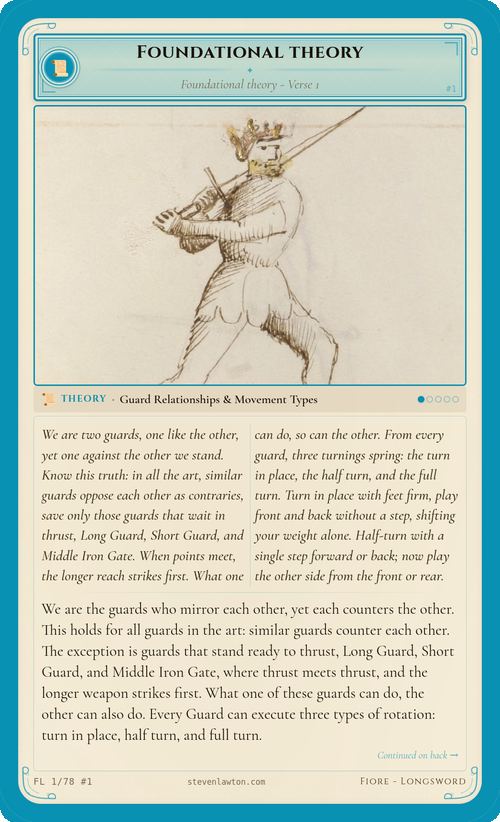
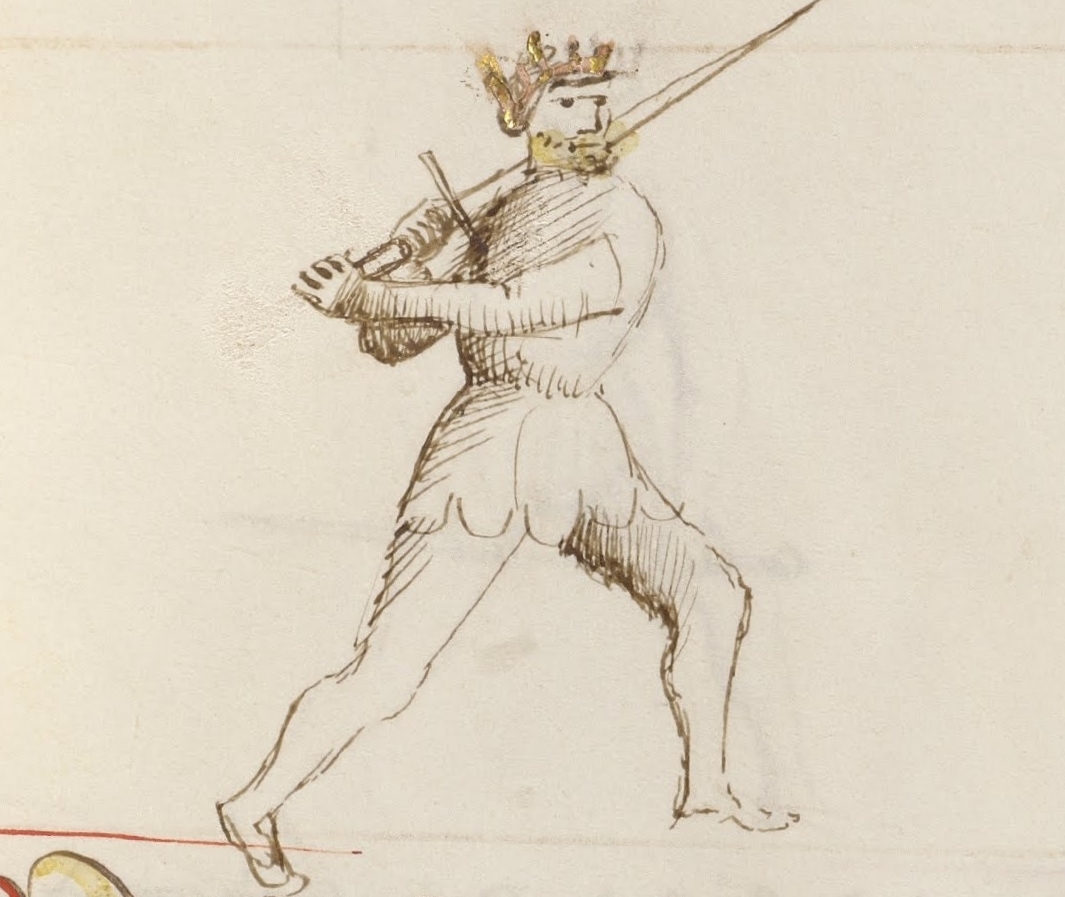
We are the guards who mirror each other, yet each counters the other. This holds for all guards in the art: similar guards counter each other. The exception is guards that stand ready to thrust, Long Guard, Short Guard, and Middle Iron Gate, where thrust meets thrust, and the longer weapon strikes first. What one of these guards can do, the other can also do. Every Guard can execute three types of rotation: turn in place, half turn, and full turn. A turn in place means you remain stationary with your feet, and you can play to the front and rear on the same side by shifting your weight. A half turn requires stepping forward or backward, allowing you to switch sides and play on the opposite side from either a forward or backward position. A full turn involves circling one foot around the other while keeping one foot anchored. The sword itself makes these same three movements: turn in place, half turn, and full turn. These two guards below are both called the Guard of the Lady. Four fundamental movements exist in this art: passing forward, returning, advancing, and withdrawing.
Fiore's Words
We are two guards, one like the other, yet one against the other we stand. Know this truth: in all the art, similar guards oppose each other as contraries, save only those guards that wait in thrust, Long Guard, Short Guard, and Middle Iron Gate. When points meet, the longer reach strikes first. What one can do, so can the other. From every guard, three turnings spring: the turn in place, the half turn, and the full turn. Turn in place with feet firm, play front and back without a step, shifting your weight alone. Half-turn with a single step forward or back; now play the other side from the front or rear. Full turn by circling one foot around the other, one planted, one moving round. The sword itself makes these same three turns: stable turn, half turn, full turn. We guards below share one name: Guard of the Lady. Four movements make up the foundation: pass forward, return, advance, and withdraw. Master these, and all else follows.
Combat Context
This verse establishes theoretical foundations rather than describing a specific combat scenario. It teaches: (1) how guards relate to each other as counters, (2) the exception for thrust-oriented guards where reach determines priority, (3) the three-fold turning system applicable to both body and sword, (4) the four fundamental footwork movements. This knowledge informs all subsequent technique applications.
Training Notes
- ✦ Practice turns by keeping your feet planted and shifting your weight front to back, rotating slightly on the balls of your feet. This movement develops the 'winding' motion, which is critical to Fiore's system.
- ✦ Distinguish clearly between a half turn (requires a step, changes sides) and a turn in place (no step, same side).
- ✦ When drilling accressere/discressere, focus on which foot moves first: lead foot first = advance (increase), rear foot first = withdraw (decrease).
- ✦ Apply the three turnings to both footwork and sword movements to understand the parallel structure.
- ✦ When practising thrust-oriented guards (Long, Short, Middle Iron Gate), emphasise that reach advantage determines who strikes first when both thrust simultaneously.
This is card FL01 from the Fiore dei Liberi Sword In Two Hands deck.
Get the full deck of 78 physical training cards.
Get the deck →Next deck: Fiore Dagger - ~35 cards, in development.
[22r-a] ¶ Noii semo doi guardie una si fatta che l'altra, e una e contraria del'altra. e zaschuna altra guardia in l'arte una simile del'altra si'e contrario salvo le guardie che stano in punta zoe posta lunga e breve e meza porta di ferro che punta per punta la piu lunga fa offesa inançi. E ço che po far una po far llaltra. E zaschuna guardia po fare volta stabile e meza volta. Volta stabile si'e che stando fermo po zugar denanci e di dredo de una parte. Meza volta si'e quando uno fa un passo o inanzi o indredo, e chossi po zugare del'altra parte denanzi e di dredo. Tutta volta si'e quan uno va intorno uno pe cum l'altro pe, l'uno staga ferma e l'altro lo circundi. E perzo digo che la spada si ha tre movimenti, çoe volta stabile, meza volta, e tutta volta. E queste guardie sono chiamate l'una e l'altra posta di donna. Anchora sono ·ⅲⅰ· cose in l'arte, çoe passare, tornare, Acressere, e discressere.
We are two guards that are similar to each other, and yet each one is a counter to the other. And for all other guards in this art, guards that are similar are counters to each other, with the exception of the guards that stand ready to thrust—the Long Guard, the Short Guard and the Middle Iron Gate. For when it is thrust against thrust the weapon with the longer reach will strike first. And whatever one of these guards can do so can the other. And from each guard you can make a “turn in place” or a half turn. A turn in place is when without actually stepping[1] you can play to the front and then to the rear on the same side. A half turn is when you make a step forwards or backwards and can switch sides to play on the other side from a forwards or backwards position. A full turn is when you circle one foot around the other, one remaining where it is while the other rotates around it. Furthermore you should know that the sword can make the same three movements, namely stable turn, half turn and full turn. Both of these guards drawn below are named the Guard of the Lady. Also, there are four types of movement[2] in this art, namely passing forwards, returning,[3] advancing,[4] and withdrawing.[5]