
Narrow Play - Verse 53
Throat cut after throw, checking for neck amour first
Translation
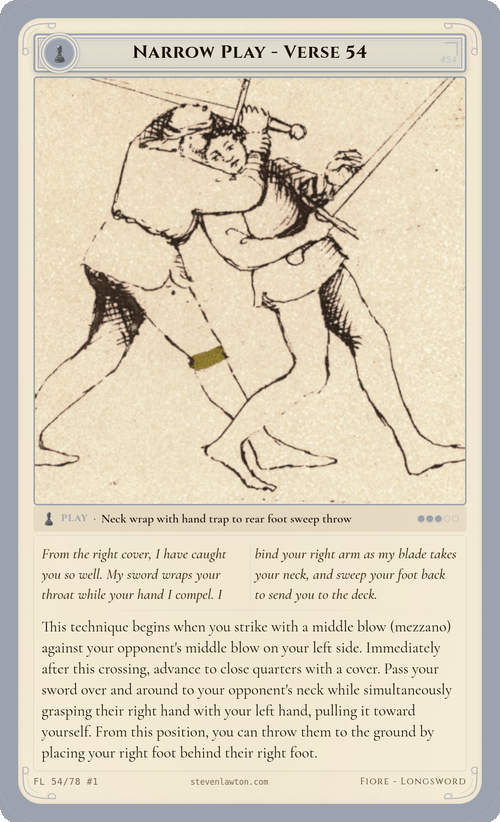
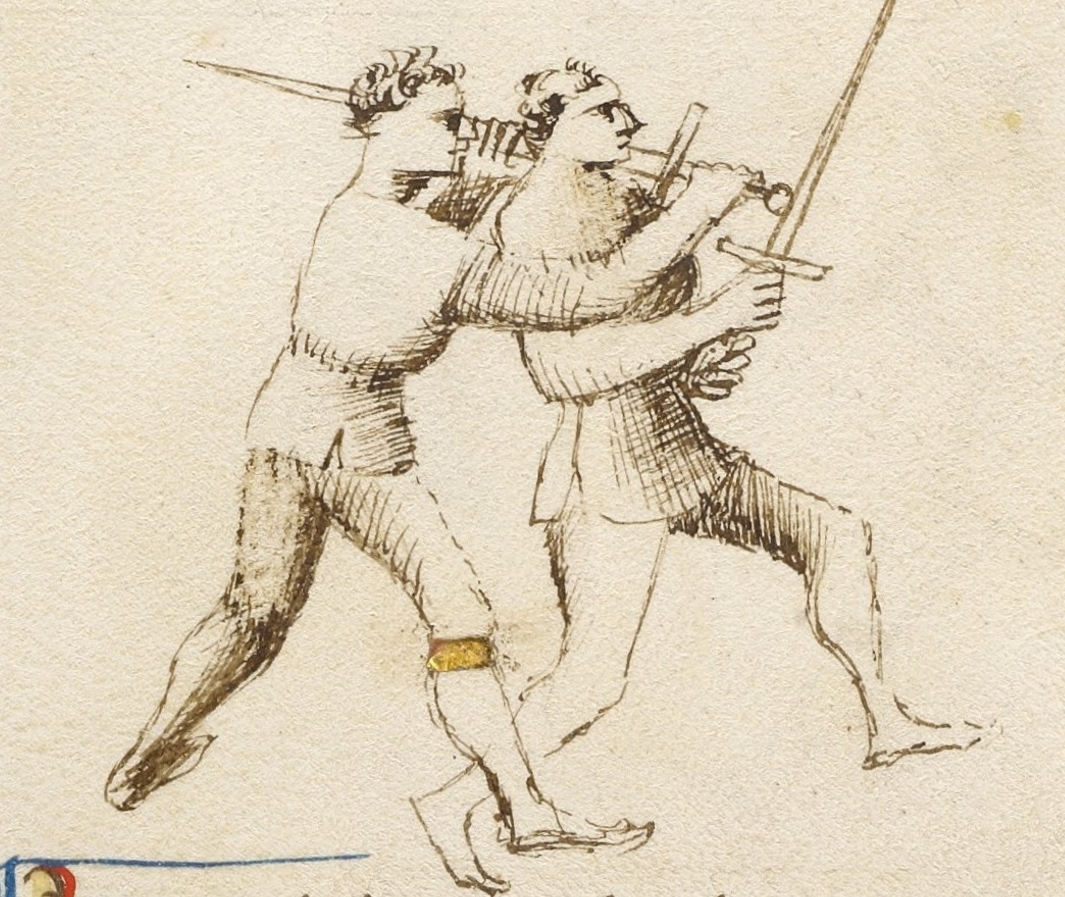
This technique follows from the previous narrow play (verse 51). After completing that action, you have thrown your opponent to the ground and now place the edge of your sword against their neck. From this position, check whether they are wearing a gorget or neck armour. If they have no collar protection, you can cut their throat.
Fiore's Words
From the play before me, just as my Scholar said, I've put my sword edge to your neck, you're nearly dead. I feel you have no collar there to save your skin, so now I'll cut your throat and let the ending begin.
Combat Context
This is a concluding action in an armoured sword combat sequence. After successfully executing a throw from close quarters (narrow play), you have a momentary advantage with your opponent on the ground or heavily compromised. The technique involves a quick tactical assessment of whether your opponent's armour has vulnerabilities at the neck, a common weak point even in full harness. If unprotected, the throat cut is a fight-ending action. This represents the transition from controlling technique to lethal finish.
Training Notes
- ✦ This is a finishing technique following a successful throw from verse 51. Practice the transition smoothly
- ✦ After throwing your opponent, maintain control of your sword and quickly position the edge against their neck
- ✦ The 'feeling' for armour can be done visually or through light contact, practice, and assessing armour in the moment
- ✦ Your right foot position (inside/behind opponent's right foot per editorial notes) helps control their body and prevents escape
- ✦ In training, use only controlled pressure. The throat is extremely vulnerable
- ✦ The technique assumes your opponent is on their back or significantly disadvantaged after the throw
Related Techniques
This is card FL53 from the Fiore dei Liberi Sword In Two Hands deck.
Get the full deck of 78 physical training cards.
Get the deck →Next deck: Fiore Dagger - ~35 cards, in development.
[28v-a] ¶ Per lo zogho che m'e denanzi e como lo scolar a ditto io t'o posta la spada al collo, e la gola te posso ben taglare, per che i sento che tu non hai punto de colare.
As the student who preceded me told you, after doing the previous play I now put the sword-edge into your neck. And from here, if I discover that you have no neck armor, I will easily cut your throat.
[16v-a] Per lo zogo che m'e denanci, e como lo scolar ha ditto io t'o posta la spada al collo. E lla gola te posso ben taglar. Per o ch'io sento che tu non ai punto di colaro.
From the play that came before me and as the Scholar has said, I have placed my sword at your neck and I could cut your throat well because I feel that you do not have an armored collar.
[22b-a] Io te mando in terra a'questo partito De meterte la spada al colo non o'falito
I send you to the ground in this match; I have not failed to thrust my sword to your neck.
[27r-c] ¶ Te iacio in terram magno/ quem precipis / actu Nec sum deceptus ensem tibi ponere collo.
I, the great one, throw you to the ground, you anticipating something, I am not cheating to put the sword to your neck using this action.