Narrow Play - Verse 51
Elbow grip from the bind, pommel strike face, cut head
Translation
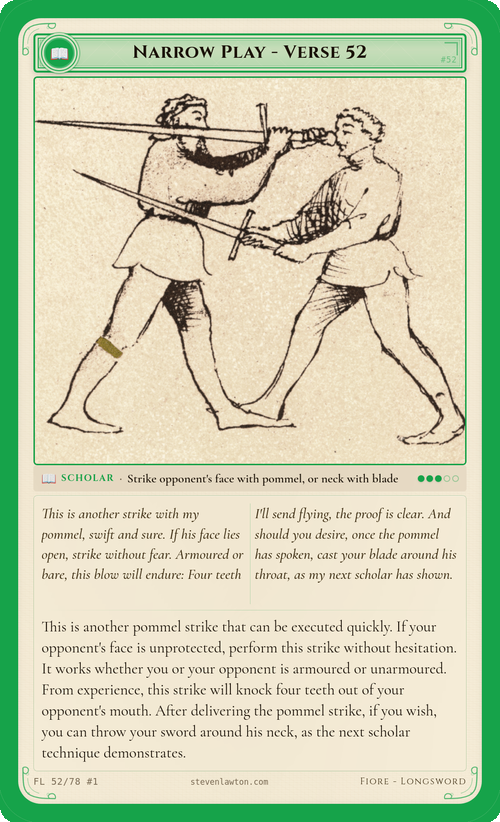
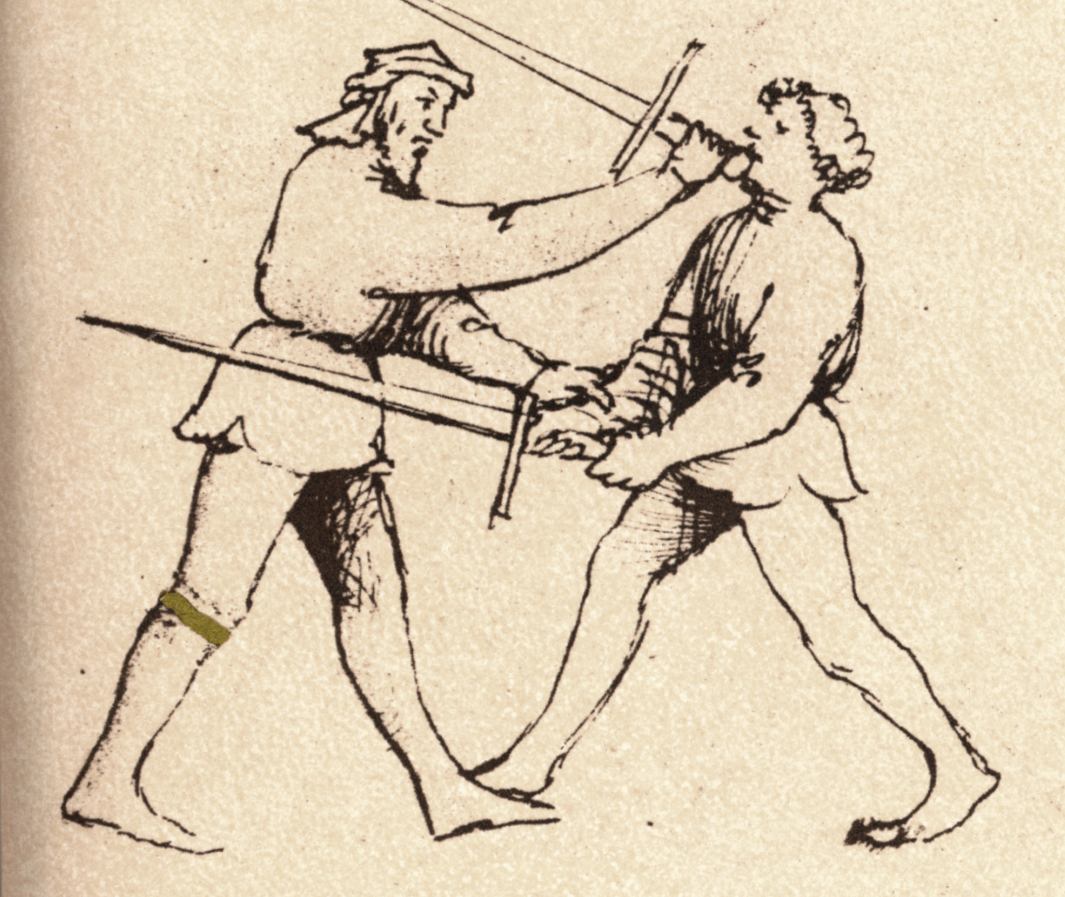
This play comes from the crossing of the Master guard. When the swords are crossed, seize your opponent's elbow as shown in the image. From this position, strike him in the face with your sword's pommel. You can also immediately follow with a descending cut to his head before he can cover himself.
Fiore's Words
I am another play born from my Master's cross. When blades meet and bind, I take what matters most: Your elbow caught firm in my grip at any cost, My pommel cracks your face. that battle's already lost. And before you raise cover or think to defend, my descending cut to your skull brings the end.
Combat Context
This technique applies when your swords cross or bind during narrow play (close measure). Your opponent has struck at your blade, or you have met his sword, creating the crossing. You capitalise on this moment by controlling his weapon arm and exploiting the close distance with the pommel and cut before he can recover his defensive posture.
Training Notes
- ✦ This technique requires recognising the crossing/bind moment and immediately transitioning from sword work to grappling
- ✦ The elbow control should be practised as a quick seizure during or immediately after blade contact; timing is critical
- ✦ The pommel strike is delivered while maintaining elbow control, using your grip to prevent his defensive movement
- ✦ Practice the pommel strike as a short, sharp arc to the face, rather than a wide swing. Speed and surprise matter more than power
- ✦ The descending cut follows naturally from the pommel strike position as your opponent reacts to the face strike
- ✦ Drill the entire sequence smoothly: bind, grip, pommel, cut; each action flows from the previous without pause
- ✦ The text emphasises that the opponent cannot make cover before your descending cut lands. Practice this timing to understand the tempo advantage created by the pommel strike
Related Techniques
Strike opponent's face with pommel, or neck with blade
Throat cut after throw, checking for neck amour first
Cross, close, sword-to-neck throw with elbow control
Seize the opponent's blade & throw them with their sword
Throw the foe with their sword after cutting their face
Counter to the left-hand sword grab in narrow play
Grip opponent's wrist, turn sword aside, strike freely
Trap opponent's arms with hilt insertion and armpit pin
Trap both arms with left, threaten with free sword
Sword around neck, throw opponent down
Pass, bind arms, thrust face, control crossguard
Seize opponent's hilt in crossing to counter disarm
Grip opponent's sword arm and twist to disarm or lock
Bind opponent's sword arm to their shoulder for control
Pin his arms while pressing your hilt into his blade
Strike disarmed opponent after partner's takeaway
This is card FL51 from the Fiore dei Liberi Sword In Two Hands deck.
Get the full deck of 78 physical training cards.
Get the deck →Next deck: Fiore Dagger - ~35 cards, in development.
[28r-c] ¶ Questo e un altro zogho che vene del incrosar del mio magistro. E commo ello e incrosado ello po fare questo zogo e'gl'altri che qui dredo siegueno. zoe, Che'lo zugadore po pigliare a questo modo lo zugadore, e ferirlo in lo volto cum lo pomo dela spada sua. Anchora po ferirlo de fendente in la testa, inançi ch'ello possa fare coverta presta.
This is another play that flows from the crossing of my Master. And from that crossing I can make this play and all of the others that follow. In this play I grip my opponent at the elbow as shown, and then strike him in the face with the pommel of my sword. After that I can also strike him in the head with a downward strike before he has a chance to make cover against me.
[16r-c] Questo e uno altro zogo che vene delo incrosar dello mio magistro. E como ello e incrosado ello po fare questo zogo e lli altri po che segueno de dredo, zoe ch'ello po fare overo piglare lo çugadore a questo modo, e ferirlo in lo volto cum lo pomo de sua spada. Anchora po ferirlo de fendente in la testa. Innanci ch'ello fare coverta presta.
This is another play that comes from the crossing of my Master, and as he is crossed, he can make this play and the others that follow after—that is, he can make or grasp the player in this way to strike him in the face with the pommel of his sword. Also, he can strike him in the head with a downward blow before [the player] could make a cover ready.
[22a-c] Per la mia spada che a'recevudo colpo E per la presa lo pomo te fier in lo volto
Because my sword has received a blow And because of this catch, my pommel strikes you in the face.
[26v-a] ¶ Hoc capulo vultum ferio tibi nempe feroci. Hoc / quia mucronem pulsasti tactibus imis.
I strike to your face using this hilt, obviously ferocious. This because you had knocked the sword using the deepest touch.