Volta
Wide Play - Verse 27
Switch sword sides from point crossing to strike opposite
Translation
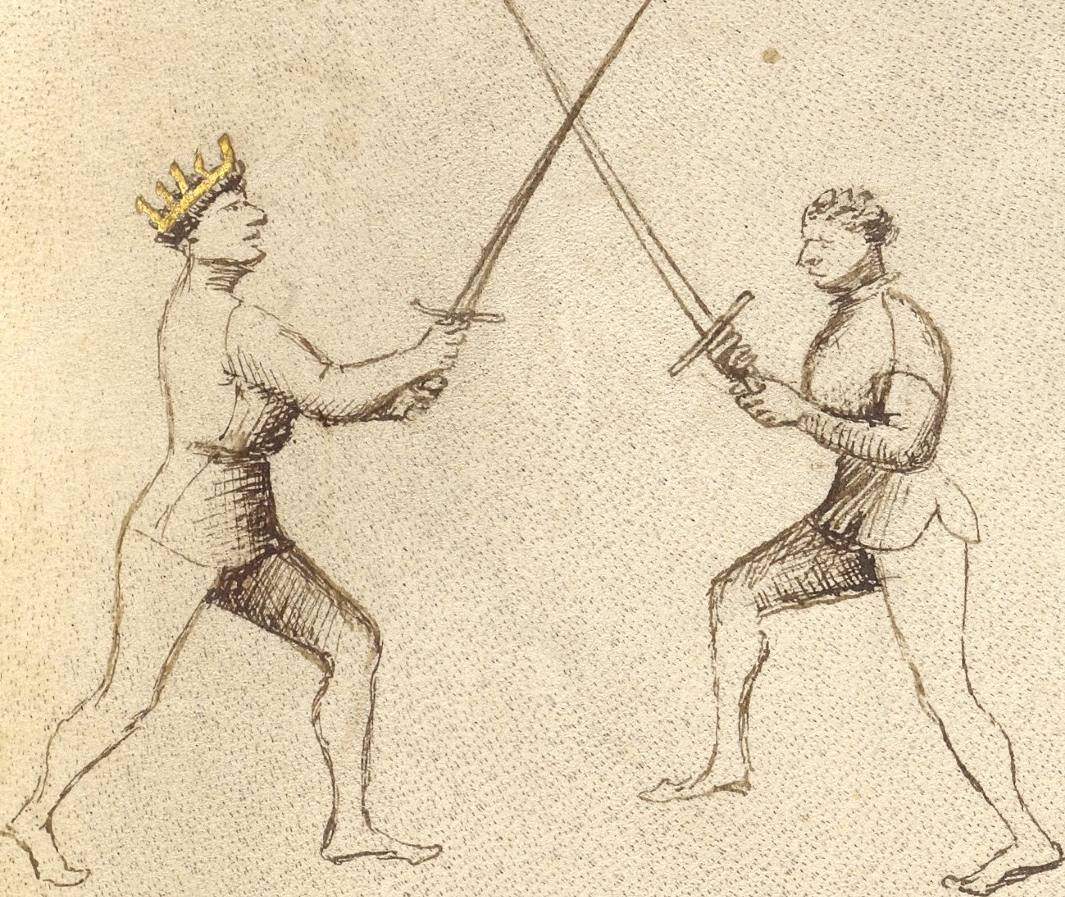
This technique begins from a crossing at the points (sword tips engaged). When you find yourself crossed at the points with your opponent, immediately turn your sword to the other side and strike with a descending cut to their head or arms. Alternatively, thrust the point into their face. The key action is the quick switch of your sword from one side to the other after the initial crossing, creating an opening for either a cut or a thrust.
Fiore's Words
When I am crossed at the point of the sword, I quickly turn my blade; this is my reward. I strike from the other side with a downward blow, through head and arms, my fendente will go. Or instead, if I choose, I place my point in your face. From crossing at tips, I've won this exchange with grace.
Combat Context
Wide play (zogo largo) at the initial engagement when swords meet at the points. This is a counter-action to use when you find yourself crossed at the tips rather than in a deeper bind. The technique exploits the opponent's sword's momentary commitment to a single line by rapidly switching to an attack from the opposite side. Suitable for the opening phases of combat when testing measures and seeking an advantage from first contact.
Training Notes
- ✦ Practice the 'volta' or switch as a rapid wrist/forearm rotation rather than a large arm movement. Speed is emphasised in all sources
- ✦ The crossing at points should be recognised as a specific measure: tips engaged but not deep in the bind
- ✦ Train both options: the descending cut targets the head and arms (multiple targets), while the thrust goes specifically to the face
- ✦ The turn creates an opening because the opponent's sword is committed to the original line of engagement
- ✦ Footwork is not specified in the text, but the switch likely coordinates with a small pass or weight shift
- ✦ The technique assumes a wide play measure (zogo largo) where the crossing at points is the initial contact
This is card FL27 from the Fiore dei Liberi Sword In Two Hands deck.
Get the full deck of 78 physical training cards.
Get the deck →Next deck: Fiore Dagger - ~35 cards, in development.
[25r-c] ¶ Qui cominza zogho di spada a doii man zogho largo. Questo magistro ch'e qui incrosado cum questo zugadore in punta de spada, dise quando io son incrosado in punta de spada, subito io do volta ala mia spada e si lo fiero dal'altra parte cum lo fendente zo per la testa e per gli brazzi, overo che gli metto una punta in lo volto, come vederi qui dredo depinto.
Here begins the Wide Play of the sword in two hands.[2] This Master who is crossed at the point of his sword with this player says: “When I am crossed at the points, I quickly switch my sword to the other side, and strike him from that side with a downward blow to his head or his arms. Alternately, I can place a thrust into his face, as the next picture will show.”
[13v] Aqui comenza zogo largo de spada a doe mane cum pocho incrosare, lo honore sera de chi meio savera fare. [13v-a] Questo magistro ch'e aqui incrosado cum questo çugadore dise quando io sono incrosado in punta de spada subito io do volta ala mia spada, e si lo fiero del'altra parte cum lo fendente zoe per la testa, e per gli brazi, overo o ch'io gli metto una punta in lo volto. Como vuii vederite qui de dredo da mi dipento.
Here begins the wide play of the sword in two hands with a little crossing; the honor will be to whoever will know to make it. This Master who is here crossed with this player says "When I am crossed at the tip of the sword, I quickly give a turn to my sword and thus I strike with a downward blow from the other side (that is, through the head and through the arms), or I thrust the point into his face as you see hereafter in my depiction."
[19b-a] Per incrosar cum ti a punta de spada Del'altra parte la'punta in lo peto t'o fermada
By crossing with you at the tip of the sword I have settled my point in your chest from the other side.
[14r-a] ¶ In cruce compressam teneo cum cuspide spatam. ☜ Ex alia secundum parte gravo cum cuspide pectus.
I hold the sword constricted in the cross[ing] with the point. Of the others I am first; I burden the chest with the point.