
Narrow Play - Verse 50
Grab opponent's hilt mid-grip after crossing swords
Translation
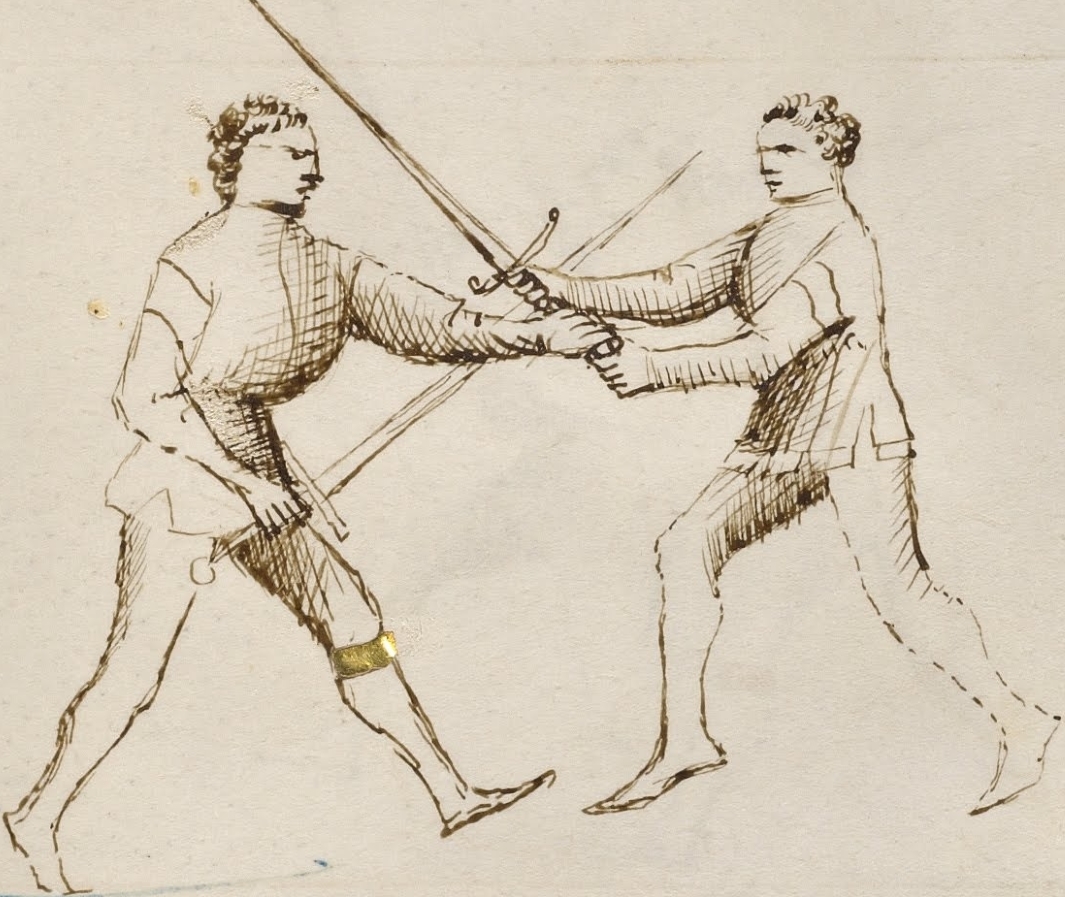
This technique follows a bind (incrosare), in which the master has crossed swords with his right foot forward. The scholar completes the first play by passing forward with his left foot. He reaches his left hand over his own right arm and grabs the opponent's sword hilt in the middle, between the opponent's hands. From this position, he can strike with either edge or point. This grip works equally well with a one-handed sword or a two-handed sword, and can be performed whether crossing over or under the opponent's blade.
Fiore's Words
From the crossing my Master made, right foot leading the way, I pass with my left and seize the day. My left hand crosses over my right arm's length, and I grab your hilt between my hands with strength. Now your sword is mine to claim. An edge or a point will end this game. One hand or two, above or below the steel, this grip works the same; your fate is sealed.
Combat Context
This technique is executed during narrow play (zogo stretto) when swords are already crossed in a bind. The master has crossed with the right foot forward, creating the tactical opportunity. The scholar exploits this bound position by advancing and seizing control of the opponent's weapon at its grip, effectively disarming while maintaining offensive capability. This represents the first play (primo zogho) from this particular crossing position.
Training Notes
- ✦ The bind (incrosare) must already be established with swords crossed before attempting this technique
- ✦ Pass forward with your left foot to close the distance while the swords are engaged
- ✦ Your left hand must reach over your own right arm (which is holding your sword) to access the opponent's hilt; this requires committed forward movement
- ✦ Target the centre of the opponent's grip, between their hands. This provides maximum leverage and control
- ✦ Once you control the hilt, you have control of both swords and can strike safely with either edge or point
- ✦ Practice this from both upper and lower crossings to understand how hand position affects the grab
- ✦ The technique works equally well with one or two hands on your own sword, though two hands may provide more power in the initial crossing
- ✦ Maintain pressure through the bind as you step. If you lose sword contact, the opponent can disengage
This is card FL50 from the Fiore dei Liberi Sword In Two Hands deck.
Get the full deck of 78 physical training cards.
Get the deck →Next deck: Fiore Dagger - ~35 cards, in development.
[28r-b] ¶ Per lo incrosare ch'a fatto lo magistro, cum lo pe dritto denanci io complisco lo primo zogho, zoe Che io passo cum lo pe stancho e cum la mia mane stancha passo di sopra lo mio dritto brazzo, e piglo el suo mantenir di'sua spada in mezo le soe[!] mane zoe in mezo delo mantenir. E cum taglo e punta io lo posso ferir. E questa presa si po fare a spada d'una e de doii mane. & a incrosare tanto di sopra quanto di sotta mane si po far tal presa.
Using the crossing my Master made with his right foot forward, I now complete the first play as follows: I pass forward with my left foot, and I reach over my right arm with my left hand, seizing his sword-grip in the middle, between his hands. And from here I can strike him with either my edge or my point. This grip can be made when fighting with the two-handed sword or the one-handed sword. And I can make this grip by reaching either under or over the crossed swords.
[16r-b] Per lo incrosar che a fatto lo magistro cum lo pe dritto denanci io comprischo lo primo zogo, zoe che io passo cum lo pe stancho, e cum la mia mane stancha passo di sopra lo mio dritto brazo, e piglo lo suo mantenir dela spada sua, in mezo le soe[!] mane zoe in mezo delo mantenir. E cum taio e punta, Io lo posso ferir, e questa presa se po fare cosi a spada de una mane, come a doe mane, e cosi a incrosar de sotto mane come di sopra se po far tal presa.
From the crossing that the Master has made with his right foot forward, I complete the first play—that is, I step with my left foot and I pass my left hand over my [right] arm and grasp the hilt of his sword in between his hands (in the middle of the hilt), and then I could strike with edge and point. And this catch can be made as easily with the sword in one hand as with the sword in two hands, and this catch can be made as easily crossing under the hands as over.
[22a-b] Per lo mantiger[!] tuo che in man io tegno E te feriro e tua spada sera mio pegno
Because of your hilt which I hold in my hand, I will strike you and your sword will be forfeit to me.
[26r-c] ¶ Percutiam nulloque tuum prohibente tenebo Pignore mucronem / tam turpiter ipse gubernas Jura tenedo meum. quo nunc traiectus obibis.
I would strike, and I will hold your sword; restrained by no Pledge, you conduct yourself so disgracefully By laws holding me, [which] pierced, you will now die.