Narrow Play - Verse 69
Seize opponent's hilt in crossing to counter disarm
Translation
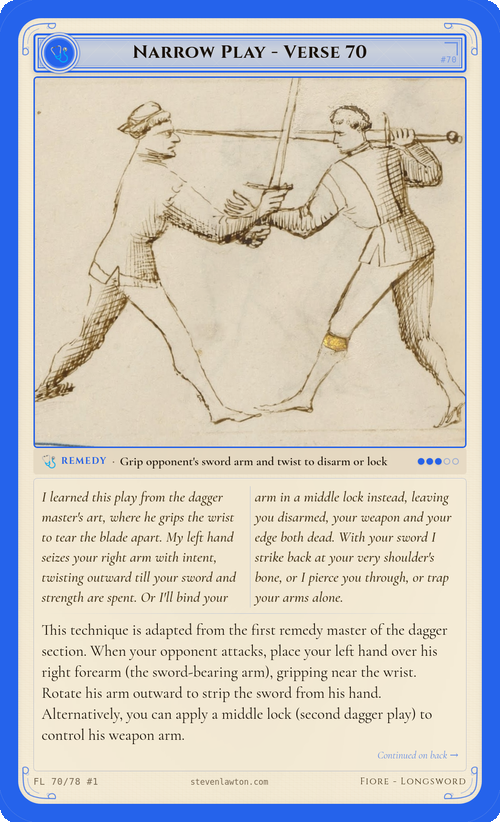
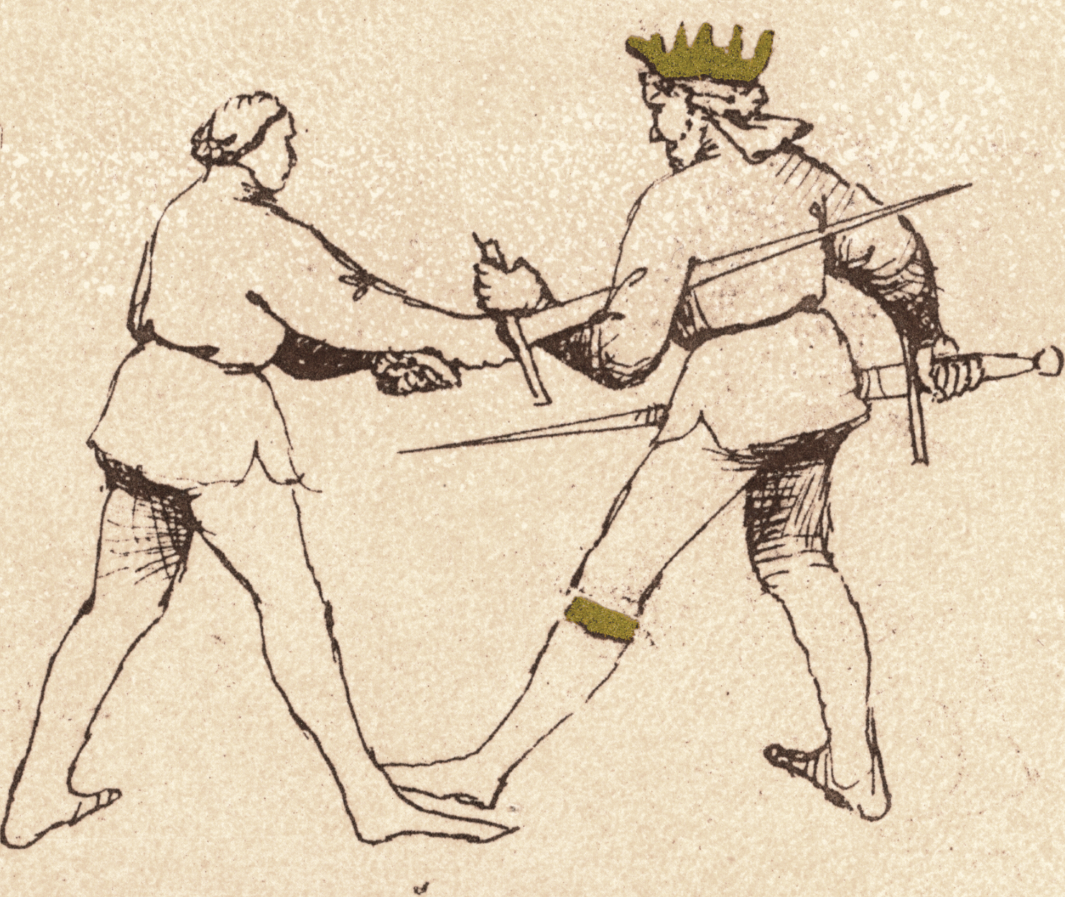
This is the counter to the sword disarm shown by the previous scholar (verse 51). I have crossed and bound your sword at the hilt by seizing it at the crossguard with my left hand while maintaining control with my own blade. From this strong crossed position, I can strike you safely with cuts or thrusts while you cannot effectively counter or remove my sword. This technique defeats all attempts to take my sword away and, if executed quickly enough, disrupts the opponent's entire narrow play game before they can establish their technique.
Fiore's Words
I make the grip the scholar before me described, Your hilt I hold, your sword I've subscribed. From here, I strike you without any fear, with cuts and thrusts, I'll sell you dear. This play breaks every sword-taking art, and, done with speed, tears the narrow play apart. I am the counter to the raised sword's threat. I hit you freely; your blade cannot beget A single touch upon my person here, for in the crossing, I control severely.
Combat Context
You are in narrow play (close distance with swords crossed). Your opponent attempts to execute a sword disarm by raising their hand to control or strip your weapon, likely the technique from verse 51. You must immediately counter by seizing their crossguard while maintaining the crossing, trapping their sword and creating safe striking opportunities. This is a high-stakes moment where speed determines success: hesitation allows them to complete their disarm, but immediate action gives you complete control.
Training Notes
- ✦ As the opponent attempts to raise their hand to disarm or control your sword, immediately cross strongly and grab their crossguard with your left hand
- ✦ Maintain your own blade in the crossing while gripping their hilt. You control both swords
- ✦ The timing is critical: this must be done 'subito' (immediately) as they begin their disarmament attempt, before they establish control
- ✦ From this position, you have multiple striking options with both point and edge, while the opponent's sword is trapped
- ✦ Practice the transition from crossed swords to hilt grab as one fluid motion
- ✦ Your grip on their crossguard prevents them from both withdrawing and completing any disarm technique
- ✦ This is explicitly designed to counter verse 51's technique, so practice against that specific attack pattern
- ✦ The 'strong in the cross' position gives you a mechanical advantage; their sword is controlled while yours remains threatening
Related Techniques
This is card FL69 from the Fiore dei Liberi Sword In Two Hands deck.
Get the full deck of 78 physical training cards.
Get the deck →Next deck: Fiore Dagger - ~35 cards, in development.
[28v-c] ¶ La presa che dise lo scolar che m'e denanzi quella ti fazo, Ferir ti posso senza impazo. E'llo elço tegno di tua spada, de punte e tagli ti faro derada. E questo zogho rompe ogni tore di spada, e lo zogho streto a farlo subito a farlo subito[12] quello guasta.
This is the grip that the student before me said to do to you. I can injure you without danger. I retain your sword's hilt, I will give you cuts and thrusts cheaply (with no risk?). And this play breaks all sword-disarms, and doing it immediately spoils the narrow play.
[16v-c] La presa che dise lo scolar che m'e denanci quella ti fazo, ferir te posso senza impazo e tegno l'elzo de tua spada, de punte e tagli ti faro derada. E questo zogo rompe ogni tore de spada e llo zogo stretto subito farlo quello guasta.
Here I am making the bind that the previous student told you about, and from this position I can strike you with impunity. I have your sword bound by its cross-guard, and from here I can strike you with both cuts and thrusts. In addition, if done quickly this play can defeat all attempts to take my sword, and if it is done quickly enough it will defeat the opponent’s Narrow Game.
[23a-b] La tua spada per l'elço si o inpresonada De tagli e de punte te faro grande derada Anche contrario son de'spada de man levar Ferir io te posso e non me la po tochar
I have trapped your sword by the hilt, And I will make you a great bargain with my edge and my point: Also, I am the counter to the sword in the raised hand; I can strike you and you are not able to touch me with the sword.
[27r-b] ¶ In cruce prevalidus proprium tibi carpo mucronem. Hinc te iam mestum cesura cuspide sive Percutiam. spätaeque manus attollere dicor Conträrium[13]. et valeo tua membra ferire patenter. Tangere nec poteris ullis violatibus ensem.
I, the very strong, seize your sword in the cross[ing]. From here I would pierce you, already gloomy, with the Cutting point. And I am called “counter of the sword”, raising The hand higher. And I prevail to strike a bargain openly with your limb. You will not be able to touch the sword with any violations.